MySQL 8.4 Release Notes
NDB 集群中的复制使用 mysql 数据库中的多个专用表,这些表位于每个作为 SQL 节点运行的 MySQL Server 实例中,无论该副本是单个服务器还是集群,这一点都适用。副本可以存在于正在被复制的集群中,也可以存在于副本集群中。Replication in NDB Cluster makes use of a number of dedicated
tables in the mysql database on each MySQL
Server instance acting as an SQL node in both the cluster being
replicated and in the replica. This is true regardless of whether
the replica is a single server or a cluster.
ndb_binlog_index 表和 ndb_apply_status 表是在 mysql 数据库中创建的。用户不应显式地进行复制。通常不需要用户干预来创建或维护这些表,因为它们都由 NDB 二进制日志(binlog)注入线程维护。这使得源 mysqld 进程能够跟踪 NDB 存储引擎执行的更改。NDB binlog 注入线程 直接从 NDB 存储引擎获取事件。NDB 注入器负责捕获集群内的所有数据事件,并确保所有更改、插入或删除数据的事件都记录在 ndb_binlog_index 表中。副本 I/O(接收)线程将事件从源的二进制日志传输到副本的中继日志。The ndb_binlog_index and
ndb_apply_status tables are created in the
mysql database. They should not be explicitly
replicated by the user. User intervention is normally not required
to create or maintain either of these tables, since both are
maintained by the NDB binary log
(binlog) injector thread. This keeps the source
mysqld process updated to changes performed by
the NDB storage engine. The
NDB binlog
injector thread receives events directly from the
NDB storage engine. The
NDB injector is responsible for
capturing all the data events within the cluster, and ensures that
all events which change, insert, or delete data are recorded in
the ndb_binlog_index table. The replica I/O
(receiver) thread transfers the events from the source's
binary log to the replica's relay log.
ndb_replication 表必须手动创建。用户可以更新此表以按数据库或表执行过滤。有关更多信息,请参见 ndb_replication 表。ndb_replication 也用于 NDB 复制冲突检测和解决,以控制冲突解决;请参见 冲突解决控制。The ndb_replication table must be created
manually. This table can be updated by the user to perform
filtering by database or table. See
ndb_replication Table, for more
information. ndb_replication is also used in
NDB Replication conflict detection and resolution for conflict
resolution control; see
Conflict Resolution Control.
尽管 ndb_binlog_index 和 ndb_apply_status 是自动创建和维护的,但在为 NDB Cluster 准备复制时,建议首先检查这些表的存在性和完整性。通过直接在源端查询 mysql.ndb_binlog_index 表,可以查看二进制日志中记录的事件数据。这也可以通过在源或副本 SQL 节点上使用 SHOW BINLOG EVENTS 语句来完成。(参见 第 15.7.7.3 节,“SHOW BINLOG EVENTS 语句”。)Even though ndb_binlog_index and
ndb_apply_status are created and maintained
automatically, it is advisable to check for the existence and
integrity of these tables as an initial step in preparing an NDB
Cluster for replication. It is possible to view event data
recorded in the binary log by querying the
mysql.ndb_binlog_index table directly on the
source. This can be also be accomplished using the
SHOW BINLOG EVENTS statement on
either the source or replica SQL node. (See
Section 15.7.7.3, “SHOW BINLOG EVENTS Statement”.)
您还可以从 SHOW ENGINE NDB
STATUS 的输出中获取有用的信息。You can also obtain useful information from the output of
SHOW ENGINE NDB
STATUS.
Note
在对 NDB 表执行模式更改时,应用程序应等待发出语句的 MySQL 客户端连接中的 ALTER TABLE 语句返回后,再尝试使用更新后的表定义。When performing schema changes on
NDB tables, applications should
wait until the ALTER TABLE
statement has returned in the MySQL client connection that
issued the statement before attempting to use the updated
definition of the table.
ndb_apply_status 用于记录已从源端复制到副本的操作。如果副本上不存在 ndb_apply_status 表,ndb_restore 会重新创建它。ndb_apply_status is used to keep a record of
the operations that have been replicated from the source to the
replica. If the ndb_apply_status table does
not exist on the replica, ndb_restore
re-creates it.
与 ndb_binlog_index 的情况不同,此表中的数据并不针对 (副本) 集群中的任何单个 SQL 节点,因此 ndb_apply_status 可以使用 NDBCLUSTER 存储引擎,如下所示:Unlike the case with ndb_binlog_index, the
data in this table is not specific to any one SQL node in the
(replica) cluster, and so ndb_apply_status
can use the NDBCLUSTER storage engine, as
shown here:
CREATE TABLE `ndb_apply_status` (
    `server_id`   INT(10) UNSIGNED NOT NULL,
    `epoch`       BIGINT(20) UNSIGNED NOT NULL,
    `log_name`    VARCHAR(255) CHARACTER SET latin1 COLLATE latin1_bin NOT NULL,
    `start_pos`   BIGINT(20) UNSIGNED NOT NULL,
    `end_pos`     BIGINT(20) UNSIGNED NOT NULL,
    PRIMARY KEY (`server_id`) USING HASH
) ENGINE=NDBCLUSTER DEFAULT CHARSET=utf8mb4 COLLATE=utf8mb4_0900_ai_ci;
ndb_apply_status 表仅在副本上填充,这意味着在源端,该表永远不包含任何行;因此,在那里无需为 ndb_apply_status 分配任何 DataMemory。The ndb_apply_status table is populated only
on replicas, which means that, on the source, this table never
contains any rows; thus, there is no need to allot any
DataMemory to
ndb_apply_status there.
由于此表的数据来自源,因此它应该被允许进行复制;任何不小心阻止副本更新 ndb_apply_status 的复制过滤或二进制日志过滤规则,或者阻止源写入二进制日志的规则,都可能导致集群之间的复制无法正常运行。有关此类过滤规则可能引起的问题的更多信息,请参阅 NDB 集群之间复制及二进制日志过滤规则。Because this table is populated from data originating on the
source, it should be allowed to replicate; any replication
filtering or binary log filtering rules that inadvertently
prevent the replica from updating
ndb_apply_status, or that prevent the source
from writing into the binary log may prevent replication between
clusters from operating properly. For more information about
potential problems arising from such filtering rules, see
Replication and binary log filtering rules with replication between NDB
Clusters.
可以删除此表,但不推荐这样做。删除它会使所有 SQL 节点进入只读模式;NDB 会检测到此表已被删除,并重新创建它,此后又可以执行更新操作。删除并重新创建 ndb_apply_status 会在二进制日志中产生一个间隙事件;该间隙事件会导致副本 SQL 节点停止从源应用更改,直到重新启动复制通道。It is possible to delete this table, but this is not
recommended. Deleting it puts all SQL nodes in read-only mode;
NDB detects that this table has been dropped,
and re-creates it, after which it is possible once again to
perform updates. Dropping and re-creating
ndb_apply_status creates a gap event in the
binary log; the gap event causes replica SQL nodes to stop
applying changes from the source until the replication channel
is restarted.
此表中 epoch 列的 0 表示事务来源于 NDB 以外的存储引擎。0 in the epoch column of
this table indicates a transaction originating from a storage
engine other than NDB.
ndb_apply_status 用于记录从上游源复制到副本集群的事务已经被应用到哪个时间点。此信息会在 NDB 在线备份中捕获,但(按设计)不会被 ndb_restore 恢复。在某些情况下,将这些信息恢复以用于新的设置可能会很有帮助;您可以通过使用 ndb_restore 并加上 --with-apply-status 选项来实现。有关更多信息,请参见该选项的描述。ndb_apply_status is used to record which
epoch transactions have been replicated and applied to a replica
cluster from an upstream source. This information is captured in
an NDB online backup, but (by design) it is
not restored by ndb_restore. In some cases,
it can be helpful to restore this information for use in new
setups; you can do this by invoking
ndb_restore with the
--with-apply-status option.
See the description of the option for more information.
NDB 集群复制使用 ndb_binlog_index 表来存储二进制日志的索引数据。由于该表是每个 MySQL 服务器本地的,并不参与集群,因此它使用 InnoDB 存储引擎。这意味着它必须在每个参与源集群的 mysqld 上单独创建。(二进制日志本身包含来自集群中所有 MySQL 服务器的更新。)该表定义如下:NDB Cluster Replication uses the
ndb_binlog_index table for storing the binary
log's indexing data. Since this table is local to each
MySQL server and does not participate in clustering, it uses the
InnoDB storage engine. This means
that it must be created separately on each
mysqld participating in the source cluster.
(The binary log itself contains updates from all MySQL servers
in the cluster.) This table is defined as follows:
CREATE TABLE `ndb_binlog_index` (
    `Position` BIGINT(20) UNSIGNED NOT NULL,
    `File` VARCHAR(255) NOT NULL,
    `epoch` BIGINT(20) UNSIGNED NOT NULL,
    `inserts` INT(10) UNSIGNED NOT NULL,
    `updates` INT(10) UNSIGNED NOT NULL,
    `deletes` INT(10) UNSIGNED NOT NULL,
    `schemaops` INT(10) UNSIGNED NOT NULL,
    `orig_server_id` INT(10) UNSIGNED NOT NULL,
    `orig_epoch` BIGINT(20) UNSIGNED NOT NULL,
    `gci` INT(10) UNSIGNED NOT NULL,
    `next_position` bigint(20) unsigned NOT NULL,
    `next_file` varchar(255) NOT NULL,
    PRIMARY KEY (`epoch`,`orig_server_id`,`orig_epoch`)
) ENGINE=InnoDB DEFAULT CHARSET=utf8mb4 COLLATE=utf8mb4_0900_ai_ci;
Note
如果您正在从较旧的版本升级,请执行 MySQL 升级程序,并确保通过使用 --upgrade=FORCE 选项启动 MySQL 服务器来升级系统表。系统表升级会导致为该表执行 ALTER TABLE ...
ENGINE=INNODB 语句。为了向后兼容,该表继续支持使用 MyISAM 存储引擎。If you are upgrading from an older release, perform the MySQL
upgrade procedure and ensure that the system tables are
upgraded by starting the MySQL server with the
--upgrade=FORCE option. The system table
upgrade causes an
ALTER TABLE ...
ENGINE=INNODB statement to be executed for this
table. Use of the MyISAM storage engine for
this table continues to be supported for backward
compatibility.
ndb_binlog_index 在转换为 InnoDB 后可能需要额外的磁盘空间。如果这成为问题,您可以通过为此表使用 InnoDB 表空间、将其 ROW_FORMAT 更改为 COMPRESSED,或两者兼施来节省空间。有关更多信息,请参见 第 15.1.21 节,“CREATE TABLESPACE 语句”,以及 第 15.1.20 节,“CREATE TABLE 语句”,还有 第 17.6.3 节,“表空间”。ndb_binlog_index may require additional
disk space after being converted to InnoDB.
If this becomes an issue, you may be able to conserve space by
using an InnoDB tablespace for this table,
changing its ROW_FORMAT to
COMPRESSED, or both. For more information,
see Section 15.1.21, “CREATE TABLESPACE Statement”, and
Section 15.1.20, “CREATE TABLE Statement”, as well as
Section 17.6.3, “Tablespaces”.
ndb_binlog_index 表的大小取决于每个二进制日志文件的时期数以及二进制日志文件的数量。每个二进制日志文件的时期数通常取决于每个时期生成的二进制日志量以及二进制日志文件的大小,时期越小,每个文件的时期数越多。你应该注意,即使 --ndb-log-empty-epochs 选项为 OFF,空时期仍会向 ndb_binlog_index 表插入数据,这意味着每个文件的条目数取决于文件使用的时间长度;这种关系可以通过下面显示的公式表示:The size of the ndb_binlog_index table is
dependent on the number of epochs per binary log file and the
number of binary log files. The number of epochs per binary log
file normally depends on the amount of binary log generated per
epoch and the size of the binary log file, with smaller epochs
resulting in more epochs per file. You should be aware that
empty epochs produce inserts to the
ndb_binlog_index table, even when the
--ndb-log-empty-epochs option is
OFF, meaning that the number of entries per
file depends on the length of time that the file is in use; this
relationship can be represented by the formula shown here:
[number of epochs per file] = [time spent per file] / TimeBetweenEpochs
A busy NDB Cluster writes to the binary log regularly and
presumably rotates binary log files more quickly than a quiet
one. This means that a “quiet” NDB Cluster with
--ndb-log-empty-epochs=ON can
actually have a much higher number of
ndb_binlog_index rows per file than one with
a great deal of activity.
当mysqld 使用--ndb-log-orig 选项启动时,orig_server_id 和 orig_epoch 列分别存储事件发生的源服务器 ID 以及事件在源服务器上发生的纪元,这在使用多个源的 NDB Cluster 复制设置中非常有用。在多源设置中用于查找副本上最高已应用纪元的最接近二进制日志位置的SELECT 语句(参见第 25.7.10 节,“NDB Cluster 复制:双向和循环复制”)使用了这两列,而它们没有索引。这可能会导致在尝试故障转移时出现性能问题,因为查询必须执行表扫描,尤其是在源服务器已使用--ndb-log-empty-epochs=ON 运行时。您可以通过为这些列添加索引来改善多源故障转移时间,如下所示:When mysqld is started with the
--ndb-log-orig option, the
orig_server_id and
orig_epoch columns store, respectively, the
ID of the server on which the event originated and the epoch in
which the event took place on the originating server, which is
useful in NDB Cluster replication setups employing multiple
sources. The SELECT statement
used to find the closest binary log position to the highest
applied epoch on the replica in a multi-source setup (see
Section 25.7.10, “NDB Cluster Replication: Bidirectional and Circular Replication”)
employs these two columns, which are not indexed. This can lead
to performance issues when trying to fail over, since the query
must perform a table scan, especially when the source has been
running with
--ndb-log-empty-epochs=ON. You
can improve multi-source failover times by adding an index to
these columns, as shown here:
ALTER TABLE mysql.ndb_binlog_index
    ADD INDEX orig_lookup USING BTREE (orig_server_id, orig_epoch);
在从单个源复制到单个副本时,添加此索引没有任何好处,因为在这种情况下用于获取二进制日志位置的查询不会使用 orig_server_id 或 orig_epoch。Adding this index provides no benefit when replicating from a
single source to a single replica, since the query used to get
the binary log position in such cases makes no use of
orig_server_id or
orig_epoch.
有关使用 next_position 和 next_file 列的更多信息,请参见 第 25.7.8 节,“使用 NDB Cluster 复制实现故障切换”。See Section 25.7.8, “Implementing Failover with NDB Cluster Replication”, for
more information about using the
next_position and
next_file columns.
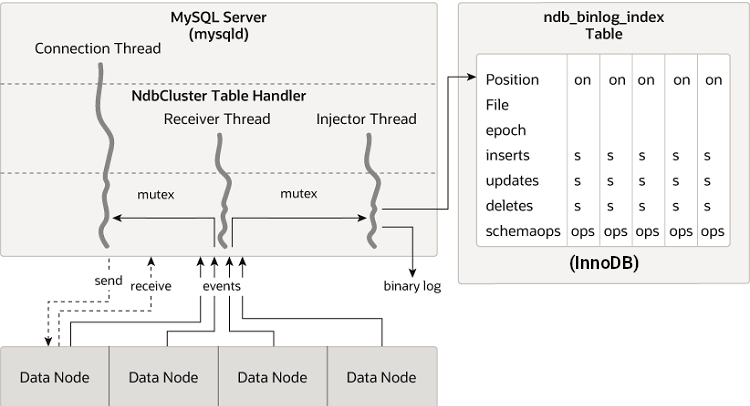
下图显示了 NDB Cluster 复制源服务器、其二进制日志注入线程和 mysql.ndb_binlog_index 表的关系。The following figure shows the relationship of the NDB Cluster
replication source server, its binary log injector thread, and
the mysql.ndb_binlog_index table.
ndb_replication 表用于控制二进制日志记录和冲突解决,并且按表为单位进行操作。该表中的每一行对应一个正在复制的表,决定如何记录该表的更改,并且如果指定了冲突解决函数,还决定如何解决该表的冲突。The ndb_replication table is used to control
binary logging and conflict resolution, and acts on a per-table
basis. Each row in this table corresponds to a table being
replicated, determines how to log changes to the table and, if a
conflict resolution function is specified, and determines how to
resolve conflicts for that table.
与 ndb_apply_status 和 ndb_replication 表不同,ndb_replication 表必须手动创建,使用此处显示的 SQL 语句:Unlike the ndb_apply_status and
ndb_replication tables, the
ndb_replication table must be created
manually, using the SQL statement shown here:
CREATE TABLE mysql.ndb_replication  (
    db VARBINARY(63),
    table_name VARBINARY(63),
    server_id INT UNSIGNED,
    binlog_type INT UNSIGNED,
    conflict_fn VARBINARY(128),
    PRIMARY KEY USING HASH (db, table_name, server_id)
)   ENGINE=NDB
PARTITION BY KEY(db,table_name);
此表的列如下,并附有描述:The columns of this table are listed here, with descriptions:
db列dbcolumn包含要复制表的数据库名称。The name of the database containing the table to be replicated.
您可以在数据库名称中使用
_和%中的任意一个或两个通配符。(请参阅本节稍后的 使用通配符匹配。)You may employ either or both of the wildcards_and%as part of the database name. (See Matching with wildcards, later in this section.)table_name列table_namecolumn要复制的表的名称。The name of the table to be replicated.
表名可以包含
_和%中的任意一个或两个通配符。请参阅本节稍后的 使用通配符匹配。The table name may include either or both of the wildcards_and%. See Matching with wildcards, later in this section.server_id列server_idcolumn表所在的 MySQL 实例(SQL 节点)的唯一服务器 ID。The unique server ID of the MySQL instance (SQL node) where the table resides.
0在此列中起到通配符的作用,相当于%,并匹配任何服务器 ID。(参见本节后面的 匹配通配符。)0in this column acts like a wildcard equivalent to%, and matches any server ID. (See Matching with wildcards, later in this section.)binlog_type列binlog_typecolumn要使用的二进制日志类型。有关值和描述,请参阅正文。The type of binary logging to be employed. See text for values and descriptions.
conflict_fn列conflict_fncolumn要应用的冲突解决函数;可选之一为 NDB$OLD()、NDB$MAX()、NDB$MAX_DELETE_WIN()、NDB$EPOCH()、NDB$EPOCH_TRANS()、NDB$EPOCH2()、NDB$EPOCH2_TRANS()、NDB$MAX_INS(),或 NDB$MAX_DEL_WIN_INS();
NULL表示该表不使用冲突解决。The conflict resolution function to be applied; one of NDB$OLD(), NDB$MAX(), NDB$MAX_DELETE_WIN(), NDB$EPOCH(), NDB$EPOCH_TRANS(), NDB$EPOCH2(), NDB$EPOCH2_TRANS() NDB$MAX_INS(), or NDB$MAX_DEL_WIN_INS();NULLindicates that conflict resolution is not used for this table.有关这些函数及其在 NDB 复制冲突解决中的用途,请参阅 冲突解决函数。See Conflict Resolution Functions, for more information about these functions and their uses in NDB Replication conflict resolution.
一些冲突解决函数 (
NDB$OLD(),NDB$EPOCH(),NDB$EPOCH_TRANS()) 需要使用一个或多个用户创建的异常表。请参阅 冲突解决异常表。Some conflict resolution functions (NDB$OLD(),NDB$EPOCH(),NDB$EPOCH_TRANS()) require the use of one or more user-created exceptions tables. See Conflict Resolution Exceptions Table.
要启用 NDB 复制的冲突解决,必须在 SQL 节点上创建并填写此表,以提供冲突应解决的控制信息。根据所使用的冲突解决类型和方法,这可能是在源服务器、副本服务器或两个服务器上。在数据也可以在副本本地更改的简单源-副本设置中,这通常是副本服务器。在更复杂的复制方案中,例如双向复制,这通常涉及所有源服务器。有关更多信息,请参见 第 25.7.12 节,“NDB 集群复制冲突解决”。To enable conflict resolution with NDB Replication, it is necessary to create and populate this table with control information on the SQL node or nodes on which the conflict should be resolved. Depending on the conflict resolution type and method to be employed, this may be the source, the replica, or both servers. In a simple source-replica setup where data can also be changed locally on the replica this is typically the replica. In a more complex replication scheme, such as bidirectional replication, this is usually all of the sources involved. See Section 25.7.12, “NDB Cluster Replication Conflict Resolution”, for more information.
ndb_replication 表允许在冲突解决范围之外对二进制日志进行表级控制,在这种情况下,conflict_fn 被指定为 NULL,而其余列值用于控制给定表或与通配符表达式匹配的一组表的二进制日志。通过为 binlog_type 列设置适当的值,可以使给定表或表组的日志使用所需的二进制日志格式,或完全禁用二进制日志。此列的可能值及其描述如下表所示:The ndb_replication table allows table-level
control over binary logging outside the scope of conflict
resolution, in which case conflict_fn is
specified as NULL, while the remaining column
values are used to control binary logging for a given table or
set of tables matching a wildcard expression. By setting the
proper value for the binlog_type column, you
can make logging for a given table or tables use a desired
binary log format, or disabling binary logging altogether.
Possible values for this column, with
values and descriptions, are shown in the following table:
表 25.42 binlog_type 值及其描述Table 25.42 binlog_type values, with values and descriptions
| 价值Value | 说明Description |
|---|---|
| 0 | 使用服务器默认值Use server default |
| 1 | 不要在二进制日志中记录此表(效果与 sql_log_bin = 0 相同,但仅适用于一个或多个指定的表)Do not log this table in the binary log (same effect as
sql_log_bin = 0, but
applies to one or more specified tables only) |
| 2 | 仅记录更新的属性;将这些记录为 WRITE_ROW 事件Log updated attributes only; log these as WRITE_ROW
events |
| 3 | 记录完整行,即使未更新(MySQL 服务器默认行为)Log full row, even if not updated (MySQL server default behavior) |
| 6 | 使用更新的属性,即使值未更改Use updated attributes, even if values are unchanged |
| 7 | 记录完整行,即使没有值更改;将更新记录为 UPDATE_ROW 事件Log full row, even if no values are changed; log updates as
UPDATE_ROW events |
| 8 | 将更新记录为 UPDATE_ROW;在更新前影像中仅记录主键列,在更新后影像中仅记录更新的列(效果与 --ndb-log-update-minimal 相同,但仅适用于一个或多个指定的表)Log update as UPDATE_ROW; log only primary key
columns in before image, and only updated columns in after
image (same effect as
--ndb-log-update-minimal,
but applies to one or more specified tables only) |
| 9 | 日志更新为 UPDATE_ROW;在更新前图像中仅记录主键列,在更新后图像中记录除主键列之外的所有列Log update as UPDATE_ROW; log only primary key
columns in before image, and all columns other than
primary key columns in after image |
Note
binlog_type 值 4 和 5 未使用,因此在刚显示的表格中以及下一个表格中均被省略。binlog_type values 4 and 5 are not used,
and so are omitted from the table just shown, as well as from
the next table.
多个 binlog_type 值相当于各种 mysqld 日志选项 --ndb-log-updated-only、--ndb-log-update-as-write 和 --ndb-log-update-minimal 的组合,如下表所示:Several binlog_type values are equivalent to
various combinations of the mysqld logging
options --ndb-log-updated-only,
--ndb-log-update-as-write, and
--ndb-log-update-minimal, as
shown in the following table:
表 25.43 binlog_type 值与 NDB 日志选项等效组合Table 25.43 binlog_type values with equivalent combinations of NDB logging options
| 价值Value | --ndb-log-updated-only 值--ndb-log-updated-only Value |
--ndb-log-update-as-write 值--ndb-log-update-as-write Value |
--ndb-log-update-minimal 值--ndb-log-update-minimal Value |
|---|---|---|---|
| 0 | -- | -- | -- |
| 1 | -- | -- | -- |
| 2 | ONON | ONON | 关闭OFF |
| 3 | 关闭OFF | ONON | 关闭OFF |
| 6 | ONON | 关闭OFF | 关闭OFF |
| 7 | 关闭OFF | 关闭OFF | 关闭OFF |
| 8 | ONON | 关闭OFF | ONON |
| 9 | 关闭OFF | 关闭OFF | ONON |
通过使用适当的 db、table_name 和 binlog_type 列值向 ndb_replication 表插入行,可以为不同的表设置不同格式的二进制日志。设置二进制日志格式时,应使用前表中显示的内部整数值。以下两个语句将二进制日志设置为对表 test.a 记录完整行(值 3),对表 test.b 仅记录更新(值 2):Binary logging can be set to different formats for different
tables by inserting rows into the
ndb_replication table using the appropriate
db, table_name, and
binlog_type column values. The internal
integer value shown in the preceding table should be used when
setting the binary logging format. The following two statements
set binary logging to logging of full rows (
value 3) for table test.a, and to logging of
updates only (
value 2) for table test.b:
# Table test.a: Log full rows
INSERT INTO mysql.ndb_replication VALUES("test", "a", 0, 3, NULL);

# Table test.b: log updates only
INSERT INTO mysql.ndb_replication VALUES("test", "b", 0, 2, NULL);
要禁用一个或多个表的日志记录,请将 binlog_type 设置为 1,如下所示:To disable logging for one or more tables, use 1
for binlog_type, as shown here:
# Disable binary logging for table test.t1
INSERT INTO mysql.ndb_replication VALUES("test", "t1", 0, 1, NULL);

# Disable binary logging for any table in 'test' whose name begins with 't'
INSERT INTO mysql.ndb_replication VALUES("test", "t%", 0, 1, NULL);
禁用某个表的日志记录相当于设置 sql_log_bin = 0,只是它是针对一个或多个单独的表。如果某个 SQL 节点没有对给定表执行二进制日志记录,它将不会接收到这些表的行更改事件。这意味着它并不是接收了所有更改然后丢弃一些,而是它根本没有订阅这些更改。Disabling logging
for a given table is the equivalent of setting
sql_log_bin = 0, except that it
applies to one or more tables individually.
If an SQL node is not performing binary logging for a given
table, it is not sent the row change events for those tables.
This means that it is not receiving all changes and discarding
some, but rather it is not subscribing to these changes.
禁用日志记录在许多情况下都很有用,包括以下列出的原因:Disabling logging can be useful for a number of reasons, including those listed here:
不在网络上传输更改通常可以节省带宽、缓冲和 CPU 资源。Not sending changes across the network generally saves bandwidth, buffering, and CPU resources.
对于更新非常频繁但其价值不高的表不记录更改,非常适合暂态数据(例如会话数据),在集群完全故障的情况下,这些数据的价值可能相对不重要。Not logging changes to tables with very frequent updates but whose value is not great is a good fit for transient data (such as session data) that may be relatively unimportant in the event of a complete failure of the cluster.
使用会话变量(或
sql_log_bin)和应用程序代码,也可以记录(或不记录)某些 SQL 语句或类型的 SQL 语句;例如,在某些情况下,可能希望不记录一个或多个表的 DDL 语句。Using a session variable (orsql_log_bin) and application code, it is also possible to log (or not to log) certain SQL statements or types of SQL statements; for example, it may be desirable in some cases not to record DDL statements on one or more tables.将复制流拆分到两个(或更多)二进制日志中,可以出于性能、需要将不同数据库复制到不同地点、对不同数据库使用不同的二进制日志类型等原因进行。Splitting replication streams into two (or more) binary logs can be done for reasons of performance, a need to replicate different databases to different places, use of different binary logging types for different databases, and so on.
使用通配符进行匹配。 为了避免在复制设置中为每一个数据库、表和 SQL 节点的组合在 ndb_replication 表中插入一行,NDB 支持在此表的 db、table_name 和 server_id 列上使用通配符匹配。分别用于 db 和 table_name 的数据库和表名可以包含以下通配符之一或两者:Matching with wildcards.
In order not to make it necessary to insert a row in the
ndb_replication table for each and every
combination of database, table, and SQL node in your
replication setup, NDB supports wildcard
matching on the this table's db,
table_name, and
server_id columns. Database and table names
used in, respectively, db and
table_name may contain either or both of
the following wildcards:
_(下划线字符):匹配零个或多个字符_(underscore character): matches zero or more characters%(百分号):匹配单个字符%(percent sign): matches a single character
(这些与 MySQL LIKE 运算符支持的通配符相同。)(These are the same wildcards as supported by the MySQL
LIKE operator.)
server_id 列支持 0 作为类似于 _(匹配任何内容)的通配符。这在前面显示的示例中有使用。The server_id column supports
0 as a wildcard equivalent to
_ (matches anything). This is used in the
examples shown previously.
ndb_replication 表中的某行可以使用通配符以任何组合匹配数据库名、表名和服务器 ID。当表中存在多个潜在匹配项时,将根据此处显示的表选择最佳匹配,其中 W 表示通配符匹配,E 表示完全匹配,Quality 列的值越大,匹配越好:A given row in the ndb_replication table can
use wildcards to match any of the database name, table name, and
server ID in any combination. Where there are multiple potential
matches in the table, the best match is chosen, according to the
table shown here, where W represents a
wildcard match, E an exact match, and the
greater the value in the Quality column,
the better the match:
表 25.44 mysql.ndb_replication 表中列的通配符匹配和精确匹配的不同组合权重Table 25.44 Weights of different combinations of wildcard and exact matches on columns in the mysql.ndb_replication table
dbdb |
table_nametable_name |
server_id |
质量Quality |
|---|---|---|---|
| WW | WW | WW | 1 |
| WW | WW | EE | 2 |
| WW | EE | WW | 3 |
| WW | EE | EE | 4 |
| EE | WW | WW | 5 |
| EE | WW | EE | 6 |
| EE | EE | WW | 7 |
| EE | EE | EE | 8 |
因此,数据库名称、表名称和服务器 ID 的精确匹配被认为是最佳(最强)的匹配,而最弱(最差)的匹配是在所有三列上使用通配符匹配。在选择应用哪条规则时,仅考虑匹配的强度;表中行的顺序不会影响此判断。Thus, an exact match on database name, table name, and server ID is considered best (strongest), while the weakest (worst) match is a wildcard match on all three columns. Only the strength of the match is considered when choosing which rule to apply; the order in which the rows occur in the table has no effect on this determination.
记录完整或部分行。 记录行有两种基本方法,这取决于 --ndb-log-updated-only 选项在 mysqld 中的设置:Logging Full or Partial Rows.
There are two basic methods of logging rows, as determined by
the setting of the
--ndb-log-updated-only option
for mysqld:
记录完整行(选项设置为
ON)Log complete rows (option set toON)只记录已更新的列数据——也就是那些已被赋值的列数据,无论该值是否实际发生了变化。这是默认行为(选项设置为
OFF)。Log only column data that has been updated—that is, column data whose value has been set, regardless of whether or not this value was actually changed. This is the default behavior (option set toOFF).
通常只记录更新的列就足够了——而且效率更高;但是,如果你需要记录整行,可以通过将 --ndb-log-updated-only 设置为 0 或 OFF 来实现。It is usually sufficient—and more efficient—to log
updated columns only; however, if you need to log full rows, you
can do so by setting
--ndb-log-updated-only to
0 or OFF.
将更改的数据记录为更新。 MySQL 服务器的 --ndb-log-update-as-write 选项的设置决定了日志记录是带有还是不带有 “before” 图像。Logging Changed Data as Updates.
The setting of the MySQL Server's
--ndb-log-update-as-write
option determines whether logging is performed with or without
the “before” image.
由于更新和删除操作的冲突解决是在 MySQL 服务器的更新处理器中完成的,因此有必要控制复制源执行的日志记录,使更新被视为更新而不是写入;也就是说,使更新被视为现有行的更改而不是新行的写入,即使这些操作会替换现有行。Because conflict resolution for updates and delete operations is done in the MySQL Server's update handler, it is necessary to control the logging performed by the replication source such that updates are updates and not writes; that is, such that updates are treated as changes in existing rows rather than the writing of new rows, even though these replace existing rows.
此选项默认开启;换句话说,更新被视为写入。也就是说,默认情况下,更新会在二进制日志中作为write_row事件写入,而不是作为update_row事件。This option is turned on by default; in other words, updates are
treated as writes. That is, updates are by default written as
write_row events in the binary log, rather
than as update_row events.
要禁用该选项,请使用 --ndb-log-update-as-write=0 或 --ndb-log-update-as-write=OFF 启动源 mysqld。当从 NDB 表复制到使用不同存储引擎的表时,必须执行此操作;有关详细信息,请参见 从 NDB 到其他存储引擎的复制 和 从 NDB 到非事务性存储引擎的复制。To disable the option, start the source
mysqld with
--ndb-log-update-as-write=0 or
--ndb-log-update-as-write=OFF. You must do this
when replicating from NDB tables to tables using a different
storage engine; see
Replication from NDB to other storage engines, and
Replication from NDB to a nontransactional storage engine,
for more information.
Important
对于使用 NDB$MAX_INS() 或 NDB$MAX_DEL_WIN_INS() 进行插入冲突解决,SQL 节点(即 mysqld 进程)可以在源集群上将行更新记录为 WRITE_ROW 事件,同时启用 --ndb-log-update-as-write 选项,以保证幂等性并优化大小。对于这些算法,这种方式可行,因为它们都将 WRITE_ROW 事件映射为插入或更新,具体取决于行是否已经存在,并且所需的元数据(时间戳列的 “after” 映像)包含在 “WRITE_ROW” 事件中。For insert conflict resolution using
NDB$MAX_INS() or
NDB$MAX_DEL_WIN_INS(), an SQL node (that
is, a mysqld process) can record row
updates on the source cluster as WRITE_ROW
events with the
--ndb-log-update-as-write
option enabled for idempotency and optimal size. This works
for these algorithms since they both map a
WRITE_ROW event to an insert or update
depending on whether the row already exists, and the required
metadata (the “after” image for the timestamp
column) is present in the “WRITE_ROW” event.